
The Best Diet for Women Over 40 (What 15 Years of Trial and Error Taught Me)
Woman holding vegan plant-forward harvest salad bowl and green smoothie
I've eaten a strict gluten-free vegan diet for six years. Before that, paleo for seven. Before that, I ate frogs’ legs in France, seaweed in China, feijoada in Brazil, and pretty much anything I wanted. Every one of those changes started the same way: a health problem, in-depth research, and a new way of eating.
Here's what fifteen years of that taught me. There is no single best diet for women over 40, no matter what the wellness gurus tell you. The way to find what works for your body isn't to follow someone else's rules harder. It's to become a scientist and learn your own.
Let me show you what I mean.
First, a plot twist: I’m not vegan anymore
For six years, plants were my whole plan. I was already gluten-free, then I removed all animal foods after a cancer diagnosis in 2018, added legumes back for protein, and eventually added healthy fats (avocados, nuts, olive oil) when whole-food plant-based left me running low.
Then I added fish and eggs back in. And I felt a little stronger.
So no, I didn't quit veganism because it "failed." I felt really good on it, and it served me well for years. My reasons for eating that way were always about my health, not animal rights, though I was glad to give the animals a break too. I stepped away from it because I changed, and my body started asking for something different. That distinction is the whole point that I want to share with you.
Why your diet keeps needing to change (it's supposed to)
Most of my diet changes started with a health issue. I'd research the nutrition around it, try a new way of eating, and experiment until I felt my best. Then a new issue would come up, and I'd tweak again. This is how it goes, you or your environment is always changing, and if we stay in tune with those changes, we can adapt.
This becomes even more true after 40. Hormones start doing new things, perimenopause shows up, muscle gets harder to hold onto, and the way you handled food at 30 starts changing. At some point you stop and notice that something is different.
The frustrating part is that this is also when the advice gets loudest. Everyone has the one diet that fixed everything for them, and a lot of it is aimed squarely at women our age. So the exact season when your body needs the most personal attention is the season you're most likely to get handed someone else's “success story”.
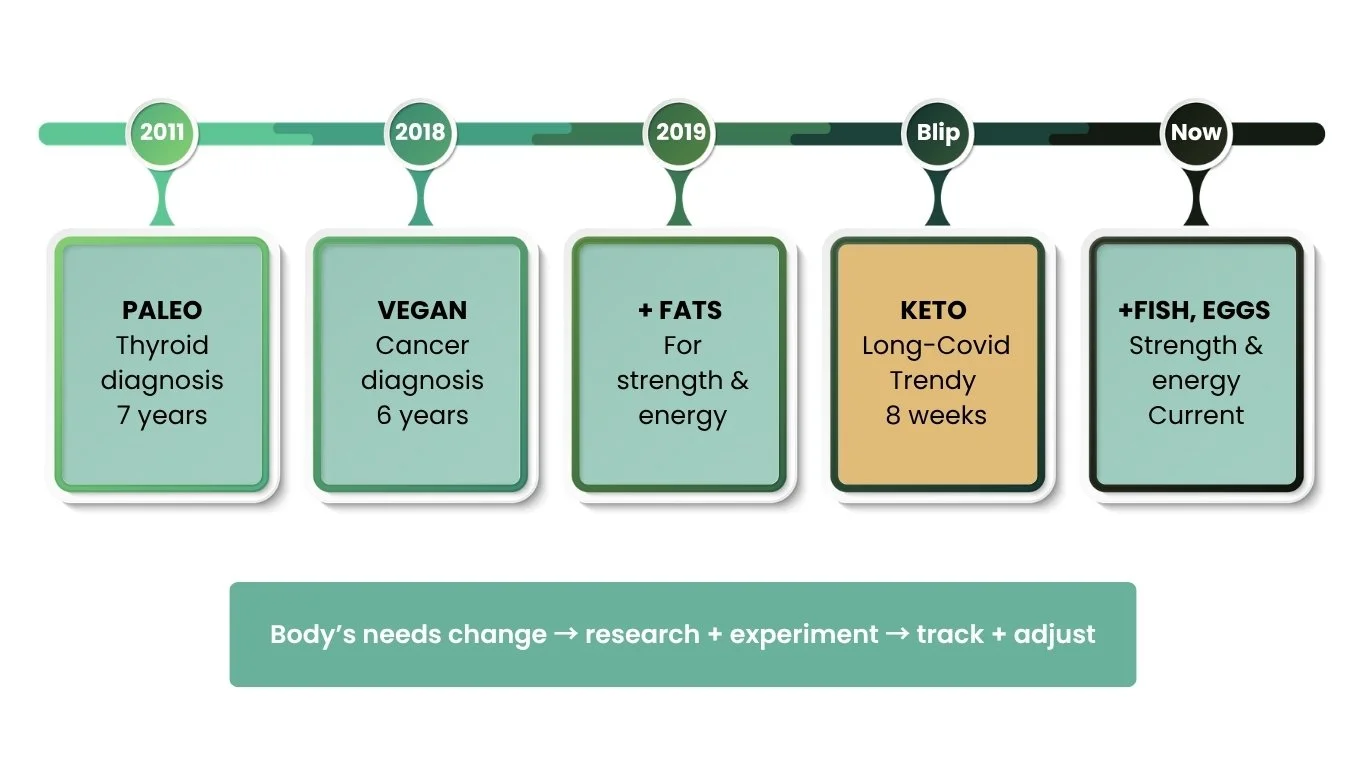
Timeline Paleo, Vegan, Fats, Keto, Fish/eggs
2011: The wake-up call. I was sleeping one to two hours a night for six months, dropped 20+ pounds in a matter of weeks, constantly hungry, constantly fidgety. The diagnosis was Graves' disease, and later Hashimoto's (both are autoimmune disorders affecting the thyroid).
Before I changed anything I ate, I ran an experiment on myself. I did an elimination diet, pulling out the usual suspects, then adding them back one at a time to see what my body would say. Gluten is strongly linked to autoimmune conditions, but rather than remove it outright, I had to test it on myself. Sure enough, gluten, refined sugar, and dairy all triggered a reaction. That elimination diet became the blueprint for how I've eaten ever since. Test, watch, adjust.
Change #1, Paleo. Gluten, grains, legumes, dairy, and refined sugar went bye-bye. Back then there were no aisles of gluten-free swaps, and I'm glad. I didn't replace the gluten-y things. I switched to naturally gluten-free foods: chicken, pork, seafood, salads, veggies, fruit. It was hard, and I did it all at once, while making sure my six-year-old would still eat dinner. But paired with stress management and compounded thyroid meds, my thyroid fluctuations started evening out. Paleo protected me for seven years.
Change #2, Vegan. After a 2018 cancer diagnosis and time with an integrative oncologist, I read the research on nutrition and cancer, and removed all animal foods. Lentils, beans, and tofu became my protein. Essentially a gluten-free, sugar-free, whole-food, plant-based way of eating (very low fat).
Change #3, Plants plus fats. I wasn't feeling great, and I assumed it was the cancer treatment. But when I added avocados, nuts, and olive oil back to my plate, my energy started coming back up. Good change, for me.
The keto detour. Then came long-Covid: vertigo, fatigue, brain fog, a constant migraine. Someone I knew swore keto fixed everything and that "every woman" over 40 should eat that way. I tried it. Eight weeks, very low carb, no meat or dairy, more tired than ever. Looking back, I was just following the crowd, one persuasive person's certainty. It didn't last.
Change #4, Fish and eggs. On my functional doctor's suggestion for more easily-digestible protein, I slowly added wild-caught fish, small fish like sardines and mackerel, and free-range eggs. The migraine stuck around, but my energy started to lift.
That's where I am now, using the same test-watch-adjust method I started with in 2011. And when I'm in Europe, I'll eat a little gluten, because luckily, it doesn't bother me there (I mean, who can resist a croissant or bagguette in France?).
The four diet principles that apply to everyone
I get irked when I hear people say "you have to eat keto to lose weight", or "paleo is the only way to eat if you have an autoimmune condition". There's solid research behind plant-forward eating for longevity, and there's research behind plenty of approaches. But only a few basics are true for all of us:
Avoid ultra-processed foods
Avoid excess alcohol
Limit exposure to pesticides and other chemicals
Eat a variety of whole foods: vegetables for fiber, fruit for antioxidants, protein for building blocks and muscle
Beyond that, there's no universal answer, no “one way” to eat for health. So don't let anyone tell you that you must eat one way, meaning their way.
How to find the best diet for your body over 40
This is what I teach my clients: Be a scientist about your own body.
You don't have to be perfect with how you eat, unless you have an allergy.
Expect your needs to change. As you age, get sick or injured, or even move somewhere with access to different foods, your nutrition needs change too. What worked at 35 may not fit at 45, and that’s ok. You’re noticing and gathering data.
Keep checking in with your body. Track what you eat, how you sleep, and how you feel. Tracking doesn’t have to be constant, perfect, or obsessive. Over time, you’ll notice patterns. Set a baseline, then add a food or remove one, and look back at how your symptoms responded. Keep what helps, and let go of what doesn't.
Find a healthcare provider who listens to you. Ideally a functional or integrative doctor who takes the time to get to know your whole picture: your goals, history, symptoms, stressors, lifestyle, and preferences.
Want a simple way to start eating for your body, without another rigid rulebook? Join my free Skool group, Natural Energy Solutions. Inside, you’ll find the Healthy Aging Blueprint, my free gift for you, plus recipes, seasonal wellness challenges, and an amazing community of women who get it.

Two hands clinking tea mugs for Natural Energy Solutions Skool group.