
Why I Quit My Vegan Diet (but you don’t have to).
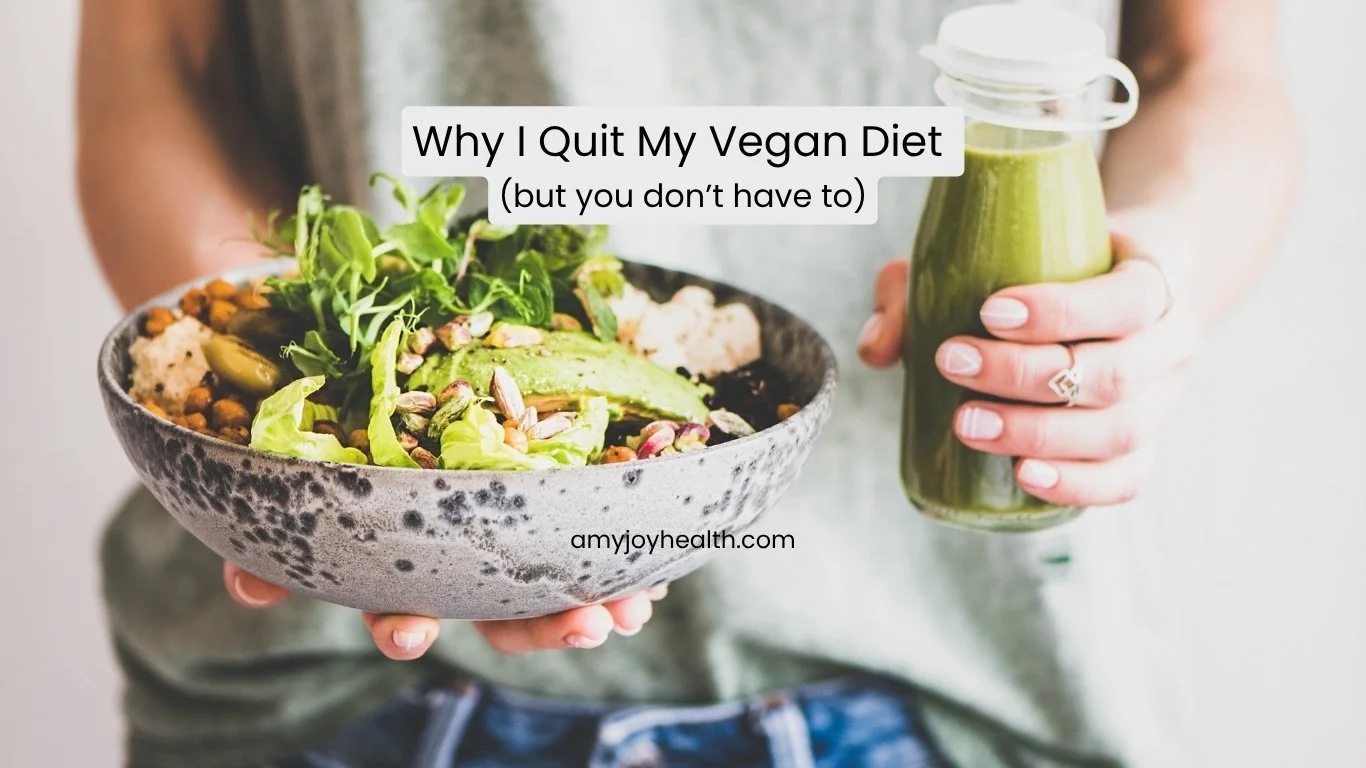
Woman holding vegan harvest bowl and green smoothie.
My diet journey and how to find what works for you.
I ate a strict gluten-free/refined sugar-free vegan diet for six years. Here, I’ll share how my diet has evolved over the past decade, and where I’m heading next.
I've been reflecting on my health journey recently and how it has driven what I eat. A lot has changed over the last 15 years.
Most of it has started with a health issue. I would research nutrition related to that health issue, try a new way of eating, and experiment until I felt my best. Then a new health issue would come up, and I’d research it, and tweak my diet again.
My typical way of eating, before health problems
Up until 2011, I travelled the world, eating pretty much anything I wanted. I sampled it all - frog legs, stinky cheeses, and croissants in Europe; exotic fish, seaweed and other seafood thoughout Asia; stews and tagines in Africa; and feijoada and pao de queijo in Brazil.
But in 2011, I was sleeping only one to two hours per night. This lasted 6 months. I lost 20+ pounds in a matter weeks. I was constantly hungry and fidgety.
After being diagnosed with an autoimmune condition (Grave's disease and later, Hashimoto's), I did an elimination diet and discovered several foods that seemed to trigger autoimmune responses.
This led to diet change #1.
Paleo Diet: Protected my autoimmune responses for 7 years.
Gluten, grains, peanuts and legumes, dairy, and refined sugars went bye-bye. Back then, we didn’t have aisles full of gluten-free alternatives to everything.
And I’m glad I didn’t have that option. I didn’t try to replace the gluten-y things; I switched over to naturally non-gluten foods like chicken, pork, seafood, fresh salads, veggies, and fruit.
It was hard to do, and I did it all at once. I learned how to stock my kitchen, figure out new recipes, plus make sure my 6-year-old would eat it.
But it was worth it. I started feeling better, and together with stress-management practices and naturally-derived compounded thyroid and autoimmune meds, the up-and-down thyroid fluctuations started evening out.
Then, in 2018, I was diagnosed with cancer. After reading the research on the connections between nutrition and cancer, and seeing an integrative oncologist, I changed up my diet again (among other changes). My culinary world became even more restictive.
I switched things up and started diet change #2.
Vegan Diet: 6 years of cancer-fighting plants.
I removed all animal foods (meat, chicken, fish, eggs), and still no gluten, peanuts, refined sugars or dairy. I slowly started adding legumes (except peanuts) back into my diet. How else would I get any protein? Fortunately, I tolerated the lentils, beans, and tofu that became my protein staples.
This was essentially a gluten-free/sugar-free whole-food, plant-based diet (WFPB). This way of eating uses very little fats and oils.
But I noticed I was not feeling very well. At the time, I thought that the cancer treatments I was undergoing were the only reason. But when I started adding in healthy fats (avocados, nuts, extra virgin olive oil), I started feeling stronger with more energy. Thus came diet change #3.
Whole Food/Plant-Based Diet + Healthy Fats
⇒ Added healthy fats. Good change (for me).
Next, I developed long-Covid, with symptoms ranging from veritgo, extreme fatigue, brain fog, and a constant migraine.
Someone I knew had lost weight on a keto diet. She now had tons of energy, ate until she was full, and her brain fog disappeared. She said “everyone” 40+ should eat this way.
I had also read that a keto diet could be beneficial for cancer recovery. I had to try it.
The challenge was: how to eat keto without eating meat or dairy? Keto is full of meat and dairy!
Keto Without Meat & Dairy: A very short experiment
Yeah, this didn’t last long. And looking back on it now, I was just following the crowd. One (persuasive) person’s declaration that keto will solve all my health problems. Not so. I stuck with it for eight weeks, but I was more fatigued than ever.
At my functional doctor's suggestion, I started slowly adding fish and eggs back into my diet in order to get animal-based protein.
Although it didn't help the migraine, I did notice my energy start to improve slightly. I began expanding what I was eating with…
Diet change #4
⇒ Added fish and eggs.
I'm pretty good with this way of eating for now. I include wild-caught fish, small fish (sardines, mackerel), and free-range eggs.
When I'm in Europe, I'll eat small amounts of gluten (it doesn't bother me there).
Next, I'm open to trying grass-fed, full-fat cow’s and sheep’s milk yogurt (again....protein).
I'm not a protein freak by any means. However, I began feeling a bit stronger when I upped the protein I was eating. Vegetarian protein tends to be fairly high in carbohydrates, and while I don't personally restrict my carb intake, I do feel better with slightly fewer carbs, and higher amounts of protein and fat.
All this to say....
What you eat is so critical to how you feel. But it's also different from person to person.
I get irked when I hear people say "you have to eat a keto diet to lose weight", or "paleo is the only way to eat if you have autoimmune dysfunction".
There is research to back up vegan/vegetarian ways of eating related to longevity.
But aside from a few basic principles that apply to everyone:
Avoid ultra-processed foods
Avoid excess alcohol
Avoid exposure to pesticides and other chemicals
Eat a variety of whole foods: vegetables (fiber), fruit (antioxidants), and protein (building blocks)
…there is no "one way" to eat.
So don’t listen when people tell you that you must eat one way (i.e. their way).
And it’s why I like to say "be a scientist". Experiment with what works for you.
Some of the principles I teach my coaching clients include:
You don't have to be "perfect" with how you eat (unless you have an allergic reaction and cannot tolerate certain foods).
Your dietary needs will change and evolve over time. As you change (through the natural aging process, illness or injury), or your environment changes (moving to a different area with access to different foods, etc), so will your nutritional needs.
Keep checking in with your body. Track what you're eating, how you're sleeping, and how you're feeling periodically. This will help you spot patterns and set a baseline. Then, you can add in different foods or remove others. Look back at how your symptoms have changed and decide whether you want to keep those dietary changes or try different ones.
Find a good healthcare provider (preferably a functional or integrative doctor) who listens to you and takes the time to get to know your whole health - your history, reactions, symptoms, lifestyle, preferences - and will work with you to get to the bottom of what may be ailing you.
If you’re looking for a simple way to eat and live that helps you feel your best, join my Skool community. It’s free and you’ll get access to recipes, quarterly wellness challenges (i.e., gut health, wellness plan), and an amazing community of women who get it.
Sign up below (it’s free!).

Two hands clinking tea mugs for Natural Energy Solutions Skool group.